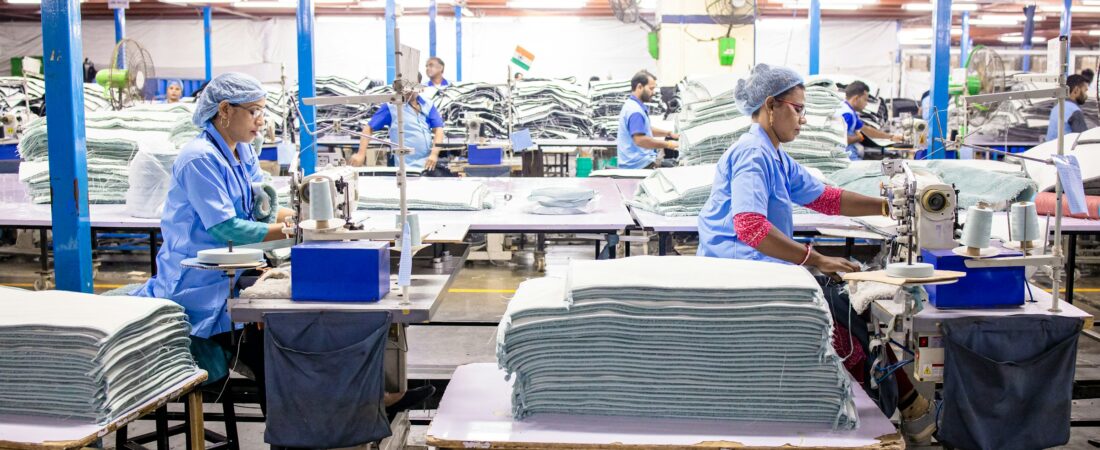
Apparel sourcing from India means finding Indian factories to develop, make and ship clothing for your brand. India offers a full cotton supply chain, skilled knit and woven factories, and growing trade access to the UK and EU. For US and EU brands, it is one of the strongest options for spreading risk beyond China.
This guide covers what India makes best, how trade deals affect your costs, what compliance you need and how to work with a sourcing partner.
Why Brands Source Apparel from India
A full supply chain in one country
India grows cotton, spins yarn, knits and weaves fabric, dyes, prints and sews. Having every step in one country cuts lead times and makes traceability easier.
Strong product skills
Different regions focus on different products:
- Tirupur: cotton knits, t-shirts, polo shirts, babywear and kidswear
- Bengaluru: wovens, trousers, jackets and workwear
- Chennai: knits, wovens, workwear and leather footwear
- Delhi NCR and Noida: fashion wovens, embroidery and ladieswear
- Mumbai: denim and fashion
- Ludhiana: woollens and knitwear
- Kolkata: basics and innerwear
Flexible order sizes
Many Indian factories can take mid-size orders. This suits brands that want more styles with smaller runs.
Trade Deals That Change the Numbers
UK
The India-UK trade deal came into force on 15 July 2026. It gives zero-duty access across 1,143 textile tariff lines. UK duties of up to 12 percent on Indian clothing have been removed.
European Union
India and the EU concluded their free trade agreement in January 2026. According to a recent update on the India-EU FTA, signing is planned for December 2026, with entry into force targeted for 2027. India’s apparel exports to the EU already reached a record 4.66 billion US dollars in the 2025 to 2026 financial year. Once the deal applies, EU duties on most Indian clothing are expected to fall to zero.
United States
US tariffs on Indian goods have changed several times since 2025. Indian industry groups warned in September 2026 that further US tariffs could hurt exports. US buyers should check current duty rates with a customs broker before costing.
Compliance You Need to Plan For
Sourcing from any country means following the rules of the market you sell in.
- EU: REACH chemical rules, textile labelling rules, the General Product Safety Regulation and PPE rules for workwear. The Forced Labour Regulation will apply from 14 December 2027.
- EU textile waste: EU countries must set up extended producer responsibility schemes for textiles by 2028. Brands will pay towards collection and recycling.
- US: CPSIA rules for kidswear, flammability rules, labelling and forced labour import rules.
- India: factories must follow the four labour codes in force since November 2025.
Typical Sourcing Timeline
| Stage | Typical time |
|---|---|
| Brief, factory shortlist and costing | 2 to 3 weeks |
| Proto and fit samples | 3 to 6 weeks |
| Fabric development and lab dips | 3 to 6 weeks |
| Size set and pre-production samples | 2 to 4 weeks |
| Bulk production | 6 to 10 weeks |
| Sea freight to Europe or the US | 3 to 6 weeks |
New styles often take four to six months from brief to delivery. Repeat styles can be much faster.
How to Work With Indian Factories
You can work directly with factories, use a sourcing agent in India or work with a garment buying house. Direct sourcing gives control but needs your own team in India. An agent or buying house gives you local people for development, follow-up and quality control.
Whatever model you choose:
- Send a complete tech pack with measurements and tolerances
- Audit each factory before the first order
- Approve fabric and trims before cutting
- Book a during production check on new styles
- Book a pre-shipment inspection before the final payment
Common Mistakes to Avoid
- Choosing a factory on price alone
- Skipping fit and size set samples to save time
- Not locking fabric quality before bulk
- Ignoring holiday periods such as Diwali
- Relying on emails without anyone on the factory floor
How Integrated Overseas Helps
Integrated Overseas has supported apparel sourcing in India since 1999. We match each style to the right partner factory, manage development and production, and check quality with our own inspectors. Our network also covers Bangladesh, Vietnam and Laos. We work with European brands and US brands alike.
Ready to plan your India range? Talk to our sourcing team.
FAQs
What clothing is India best at making?
India is strongest in cotton knits, t-shirts, polos, denim, kidswear, workwear and home textiles, with skills in embroidery and wovens.
Is it cheaper to source apparel from India or China?
It depends on the product. India is often competitive on cotton products, and zero UK duty since July 2026 helps UK buyers.
How long does apparel sourcing from India take?
New styles usually take four to six months from brief to delivery, including sampling, production and shipping.
Do I need an agent to source from India?
No, but an agent or buying house gives you local staff for development, follow-up and quality control, which reduces risk.