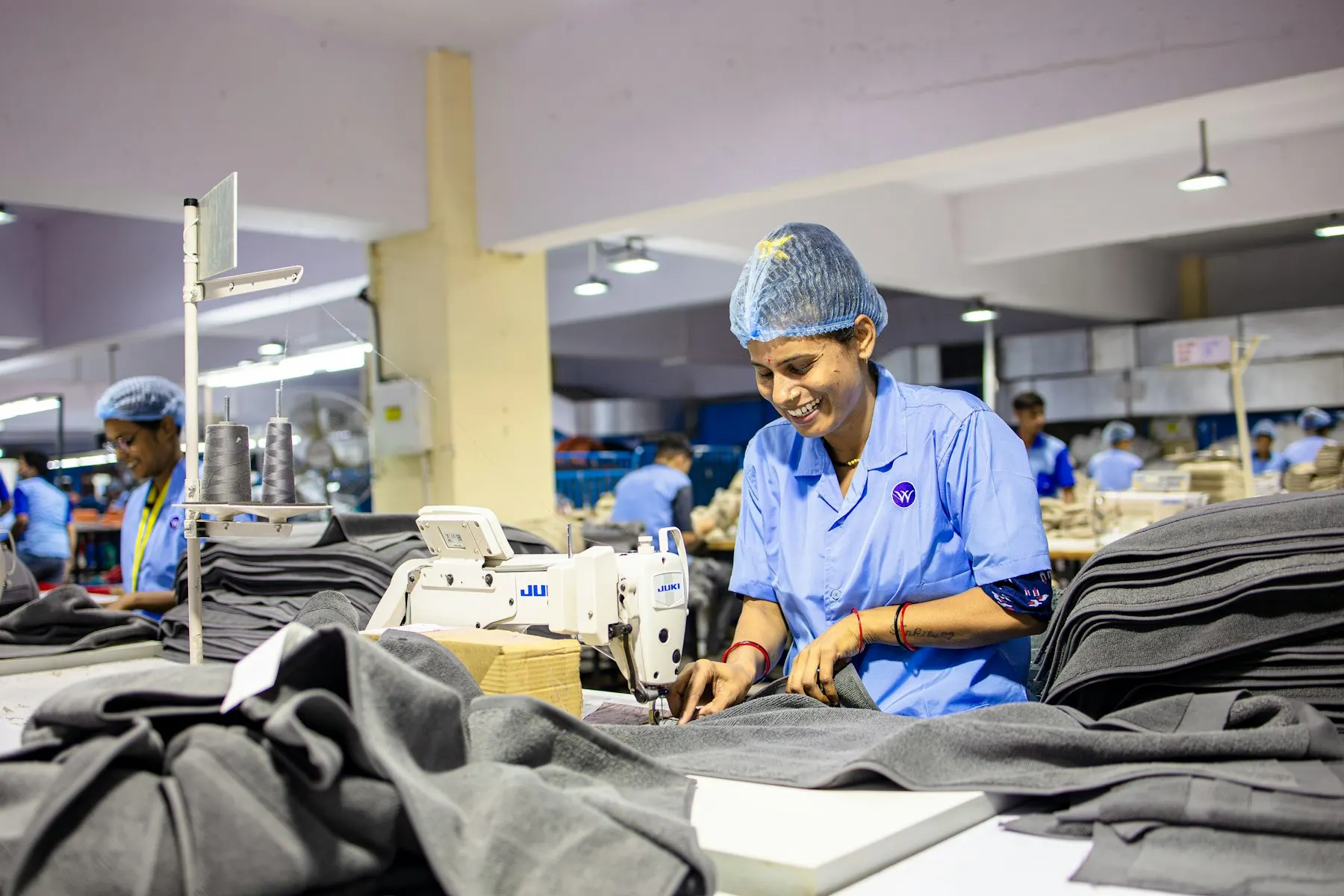
China clothing manufacturers offer huge scale, speed and material choice. Indian clothing manufacturers offer strong cotton supply chains, skilled knit and workwear factories, and better trade access to the UK and soon the EU. Neither country wins on everything. The best choice depends on your product, your market and how much risk you want in one place.
Here is a fair, side-by-side look at the factors that matter most to buyers.
The Big Picture
China is still the world’s largest clothing exporter. WTO data on 2025 clothing exports shows China held about 27 percent of the world market, but its share is falling as buyers spread orders across Asia. India’s share is smaller, yet India is one of the few countries with a full supply chain from cotton fields to finished garments.
Side-by-Side Comparison
| Factor | India | China |
|---|---|---|
| Scale | Large, but more mid-size factories | Very large, with many big factories |
| Fabric base | Strong in cotton and blends | Strong in synthetics and technical fabrics |
| Best products | Knits, tees, polos, denim, kidswear, workwear, home textiles | Outerwear, sportswear, synthetics, accessories |
| Minimums | Often flexible for mid-size orders | Varies; many large factories prefer big runs |
| Speed | Good for cotton products; some imported trims add time | Very fast, with trims close by |
| UK duty | Zero on most clothing since July 2026 | Standard UK rates |
| EU duty | Expected to fall once the India-EU deal applies | Standard EU rates |
| US forced labour risk | Lower for Xinjiang cotton, still needs checks | High priority under UFLPA for cotton and apparel |
Cost
Labour cost is only part of the price. Fabric, trims, efficiency, duty and freight all matter. For cotton basics, India is often very competitive because fabric is made close to the factory. For complex synthetic items, China often wins because every input is nearby.
Duty can change the result. The India-UK trade deal removed UK duties of up to 12 percent on Indian clothing from 15 July 2026. China does not have this access.
Quality
Both countries have excellent factories and poor ones. Quality depends far more on the factory than the country. Indian factories are known for cotton handling, embroidery and craft details. Chinese factories are known for consistent finishing and technical products.
Whatever you choose, audit the factory and inspect the goods. A factory audit and a pre-shipment inspection protect you in either country.
Lead Time
China’s dense supply clusters make it very fast, especially for synthetics and accessories. India can match China on cotton products where fabric is made locally. Lead times grow in India when special trims or synthetic fabrics must be imported. Plan for festival periods in both countries: Chinese New Year in China and Diwali in India.
Trade Deals and Market Access
- UK: India has zero-duty access on most clothing since July 2026.
- EU: The India-EU deal is set for signing in December 2026, with entry into force targeted for 2027.
- US: Tariffs on both countries have changed often since 2025. Check current rates before costing.
Compliance and Risk
US buyers must show their goods are free of Xinjiang-linked forced labour. For China sourcing, check suppliers and mills against the UFLPA Entity List and keep cotton origin records. In the EU, the Forced Labour Regulation applies from December 2027 to all countries.
India has its own risks, including subcontracting and labour rights in some regions. Its four new labour codes, in force since November 2025, aim to improve this.
When to Choose India
- Cotton knits, tees, polos and kidswear
- Workwear, uniforms and hi-vis or FR garments
- UK-bound goods that benefit from zero duty
- Brands planning for the India-EU deal
- Buyers reducing reliance on one country
When to Choose China
- Highly technical synthetic outerwear
- Products with many specialised trims
- Very large volumes on tight timelines
- Accessories and mixed-material products
Why Many Brands Use Both
A “China plus one” approach keeps China for what it does best and moves suitable styles to India. This spreads risk from tariffs, disruptions and compliance issues. Over time, some brands move more volume as Indian suppliers prove themselves.
How Integrated Overseas Helps
Integrated Overseas helps brands move suitable styles to India and nearby countries. Since 1999 we have managed apparel sourcing in India, with partner factories in Bangladesh, Vietnam and Laos too. Our team compares options by product, then manages production and quality. Read our guide to apparel sourcing from India to learn more.
Considering India for part of your range? Talk to us.
FAQs
Are Indian clothing manufacturers cheaper than Chinese ones?
For cotton products, India is often competitive. For complex synthetic products, China often costs less. Duty and freight also change the result.
Is quality better in India or China?
Both have excellent and poor factories. Quality depends on the factory, so audit suppliers and inspect goods in either country.
Which country is faster for production?
China is often faster for synthetics and trim-heavy products. India can match it on cotton products made with local fabric.
What is China plus one sourcing?
It means keeping some production in China while moving suitable styles to another country, such as India, to spread risk.